You pull into your driveway, hit the garage door opener, and park. As you step out of the car, you look down. Is your concrete floor cracked, stained with oil, or just generating endless amounts of dust? If so, you are likely considering a concrete coating to protect your investment and improve your home’s aesthetic.
For years, the standard answer for garage floors and patios was epoxy. You might have seen the DIY kits at big-box hardware stores. However, coating technology has advanced significantly. Today, homeowners are frequently choosing between traditional epoxy and a more modern, durable solution: polyurea.
Choosing the right material is the difference between a floor that lasts fifteen years and one that peels up after fifteen months. This guide breaks down the science, benefits, and drawbacks of both options so you can make the right decision for your home.
Key Takeaways
- Cure Time: Polyurea cures in just one day, allowing you to use your garage immediately, whereas epoxy can take up to a week to fully harden.
- Durability: Polyurea is significantly more flexible and stronger than epoxy, making it resistant to cracking, peeling, and UV damage.
- Investment: While epoxy may be cheaper upfront, polyurea offers better long-term value due to its lifespan and resistance to wear and tear.
What Is Concrete Coating?
Before comparing materials, it is helpful to understand what a coating system actually does. Unlike paint, which sits on top of the surface and chips easily, a true concrete coating bonds with the porous structure of the cement.
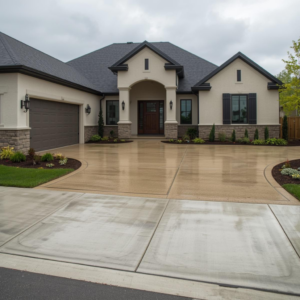
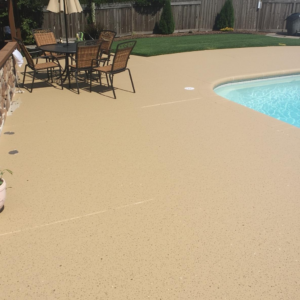
When applied correctly by a professional concrete coating contractor, the liquid polymer seeps into the concrete before hardening. This creates a seamless, non-porous surface that resists water, oil, road salts, and chemicals. While most commonly associated with garage floors, these systems are perfect for basements, patios, pool decks, and walkways.
The Old Standard: Epoxy Coatings
Epoxy has been the go-to floor coating for decades. It is a thermosetting resin that is applied as a liquid and cures into a hard, plastic-like surface.
The Pros of Epoxy
- Cost: Epoxy is generally less expensive per gallon than polyurea.
- Appearance: When fresh, epoxy provides a high-gloss finish that looks professional.
- Availability: It is widely available and understood by most general contractors.
The Cons of Epoxy
Despite its popularity, epoxy has significant limitations, particularly in residential settings.
- Temperature Sensitivity: Epoxy is very fussy about temperature. If it is too hot or too cold during installation, the bond will fail.
- Long Cure Times: Once applied, you cannot walk on an epoxy floor for several days, and you certainly cannot park your car on it. It can take up to a week to fully cure.
- “Hot Tire Pickup”: This is a common failure point. When you drive a car with hot tires onto an epoxy floor, the heat can soften the coating. As the tires cool and contract, they pull the epoxy right off the concrete, leaving ugly bald spots.
- UV Instability: Epoxy turns yellow when exposed to sunlight. If you coat a patio or a garage with windows, the floor will eventually look amber and aged.
The Modern Challenger: Polyurea
Polyurea is a subgroup of polyurethane. It was originally developed for heavy industrial use—think lining truck beds and coating industrial pipes. TSR Concrete Coatings and other industry leaders have adapted this industrial strength for residential use.
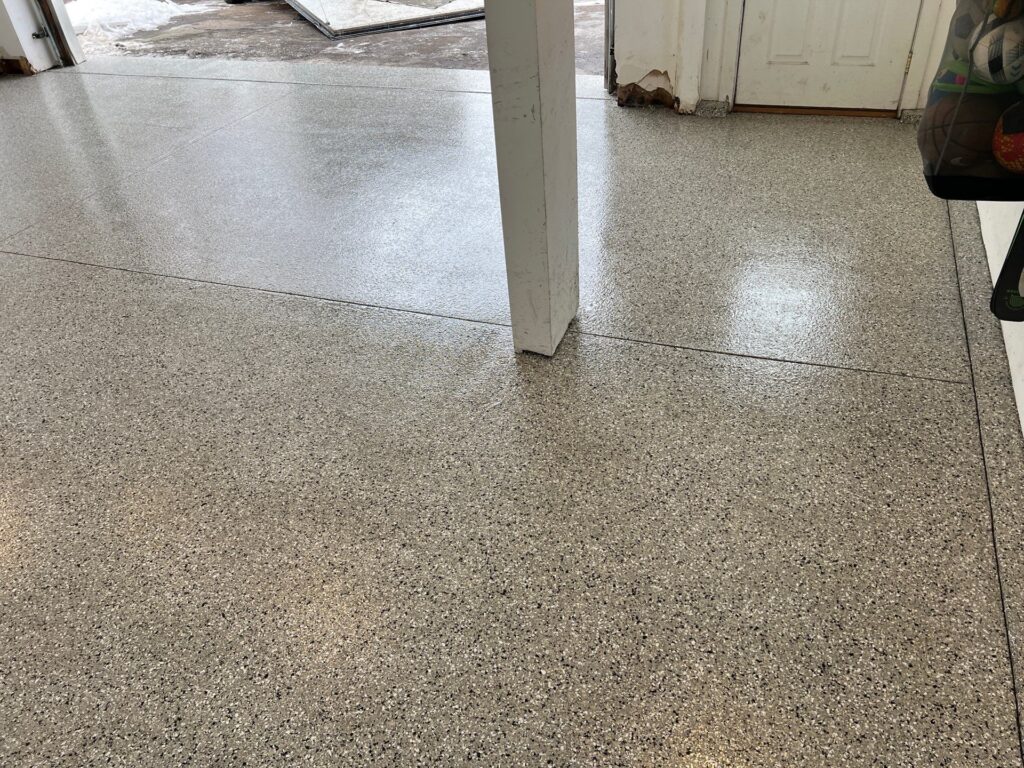
Usually, these systems are applied as a “chip system.” This involves a polyurea base coat, vinyl chips for texture and color, and a polyaspartic topcoat.
The Pros of Polyurea
- Rapid Cure Time: This is the biggest selling point for busy homeowners. Polyurea cures incredibly fast. In most cases, the installation takes one day, and you can drive on it 24 hours later.
- Flexibility: Concrete expands and contracts with changing seasons. Epoxy is rigid, so when the concrete moves, the epoxy cracks. Polyurea is flexible. It moves with the concrete, maintaining its bond without cracking.
- UV Stability: Unlike epoxy, polyurea (specifically with a polyaspartic topcoat) is UV stable. It will not yellow or fade, making it ideal for outdoor spaces like pool decks and driveways.
- Strength: It is chemically resistant to oil, gas, and salt, and it is significantly harder to scratch than epoxy.
The Cons of Polyurea
- Application Difficulty: Because it dries so fast, it has a very short “pot life.” Once mixed, it must be applied immediately. It is nearly impossible for a DIY enthusiast to apply correctly. It requires a professional crew.
- Cost: The material cost is higher than epoxy. However, given its longevity, the cost-per-year is often lower.
Head-to-Head: Durability and Climate
When choosing a floor, you have to consider where you live. If you are located in an area with distinct seasons—hot summers and freezing winters—the durability of the material is tested constantly.
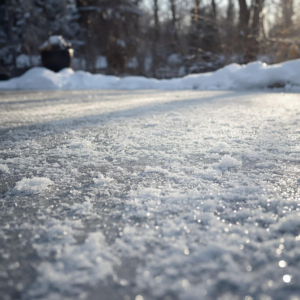
In places like Nebraska, concrete undergoes freeze-thaw cycles. Moisture gets into the pores of the concrete, freezes, expands, and causes the slab to shift or crack. If you have a rigid coating like epoxy on top, that coating will snap or delaminate.
This is why finding a specific Concrete Coating Company Omaha NE homeowners trust is vital. Local experts understand that the coating needs to handle road salts brought in during winter and the high humidity of summer. Polyurea’s flexibility allows it to survive these harsh shifts in temperature and ground movement where epoxy typically fails.
Why Professional Installation Matters
You might be tempted to save money by buying a DIY epoxy kit. While the price tag looks appealing, the failure rate of DIY kits is incredibly high.
The most critical part of a concrete coating is not the liquid itself; it is the preparation. For a coating to bond, the “pores” of the concrete must be open. A professional concrete coating contractor will use industrial diamond grinders to mechanically abrade the floor. This removes surface stains, weak concrete, and previous sealers.
DIY kits usually come with a mild acid etch solution that simply isn’t strong enough to properly prepare the concrete. Without mechanical grinding, the coating is just sitting on top of the dirt and grime, and it will peel up within a year or two.
Furthermore, professionals at TSR Concrete Coatings measure moisture levels in the slab before applying anything. High moisture levels are a death sentence for coatings. A pro knows how to mitigate this, whereas a DIYer is often flying blind.
Making the Right Choice for Your Home
Your home is likely your biggest asset. When upgrading your garage, basement, or patio, you want a solution that adds value and reduces maintenance.
While epoxy had its day in the sun, polyurea represents the future of concrete protection. Its ability to withstand hot tires, resist UV fading, and flex with the changing seasons makes it the superior choice for residential applications.
If you are ready to say goodbye to dusty, cracked concrete and hello to a showroom-quality floor, don’t rely on a temporary fix. Choose a system designed to last a lifetime.
Upgrade Your Floors with TSR Concrete Coatings
Ready to transform your space? At TSR Concrete Coatings, we specialize in high-quality polyurea systems that look great and stand the test of time. Don’t settle for peeling epoxy.
Contact us today to schedule your free consultation and see why we are the top choice for homeowners.